
Bio
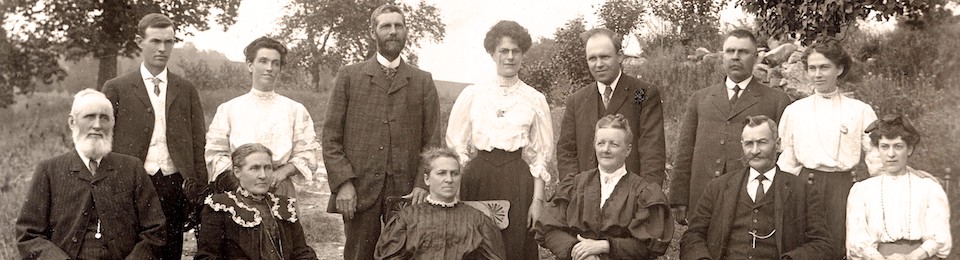
Helen Jean WATSON was born 29 August 1924 at 29 Wilmot Pl, Winnipeg, to Tom WATSON born Ayrshire, Scotland and Mary Copeland BELL born Haddington Scotland.
Helen married James Hunter DRUMMOND on 28 May 1949 and became a registered nurse around the same time. In 1954 they moved to Garrison, ND with their two sons David and Brian. Their remaining three sons Ian, Kevin and Richard (Rick) were born there. After a few years they continued on to Minneapolis where Jim worked as a radiology technician and Helen as a nurse. Helen passed away on 8 Dec 2010 in Minneapolis, survived by her husband, 5 sons and 9 grandchildren.
Memoir Glimpses – a collection of Helen’s writings about moments from her life.
Preface
Deep inside most of us is a desire, hidden or acknowledged,
to be remembered after we have gone from this earth. Or perhaps
I am taking my own inner feelings and projecting them into the
rest of humanity.
As the years fly by, and they do seem to move much more
swiftly than they used to, this deep-seated need tends to surface
more often. I wish I knew more about my ancestors, and surely
someday my children and their children will want to know more
about my generation.I feel an urgency to start recording the
memories which frequently make their presence felt.
When the Spring Quarterly for Metro U. arrived I read
about a new class being offered in Memoir Writing and it seemed
that providence was taking a hand. This must be where I should
start. I had enjoyed writing little stories and poems as a child,
and a General Writing course in winter quarter had renewed a sense
of excitement when I realized that I could let my words flow onto
paper and have someone enjoy reading them. Now I hoped to progress
to stories of my own life, and after completing just one excerpt
I knew that even if no one ever read them but myself, it would
have been worthwhile.
The selections which follow are but a ripple on the surface-
a brief look at my life as I go back and search my memory bank.
As I compared notes with my sister, I discovered that memories can
vary with the individual.This is not to say that either one is
right or wrong, but only that we all see the past from a different
angle, and recall the details which impressed us most at the time.
It was also interesting to note that each time I sat down to
tackle an assignment which struck a respondent note within me,
several other possible stories would come to mind. Sometimes I
literally had ideas tripping over each other trying to be heard.
But I also learned a valuable lesson — I could not force
a story. I might decide on a topic, but sometimes the words just
wouldn’t come. I had to learn to let my mind wander at it’s own
pace, and once it landed on the right topic, the words would
come.
This collection of pieces represents the writing which
pleased me most — I trust it appeals to the reader as well.
Helen Drummond
Reading — An Inherited Love
April, 1981
Mother never had a chance to complete her formal education ..
Her parents died when she was a teenager and she took over the
responsibility and care of a younger brother. In reality, however,
she was educated more than many college graduates. Her life
experiences certainly contributed to that education, but most
important she was an avid reader. Fortunately it is a trait which
I inherited from her.
As a pre-schooler I can remember walking to the library
with mother every two weeks. It was well over a mile, but in the
heat of summer or cold of winter it was a pleasurable event. The
children’s corner at the library was a haven of contentment. Even
before I could read , the big color picture books told fascinating
stories. No matter how busy mother was, she always found time to
read to us, and for those treasured trips to the library.
After I started school the excitement increased. My
acceptable scholastic ability could probably be credited, at least
partially, to my reading skills. Throughout my school years, books
were friends to fill lonely hours, or rainy days, or vacation time
when days became too long for sustained physical activity.
Birthdays and Christmas were sure to bring new volumes to explore.
As an adult my reading time varied with the hours available —
five young sons left little time for reading much more than bedtime
stories for children — but as the family grew up, my reading time
increased.
As I approach my college graduation, I look forward to reading
literature of choice rather than necessity, but I cannot help but
be thankful that reading was always, for me, a pleasure, not a chore.
The Depression Years
(through the eyes of a child)
May, 1981
The assignment of writing a memoir about an era you have
lived through sounded interesting, but I put it aside and tackled
a different topic. However, each time I paused I found my mind
wandering back to the idea of an era. It beckoned to me like a
tall cool glass of iced tea on a hot humid summer afternoon.
After all, I had been a small child during the Depression years
of the Thirties, and a schoolgirl during the Second World War,
so I had truly lived through two well-known ‘eras.’ Surely I
could record some interesting impressions.
I started to jot down some thoughts about the Depression
years that brought tragedy to so many lives — lost jobs, long
lines at the unemployment office, families on welfare, fathers
in despair. Suddenly I realized that I was describing what I had
been told, or read, not what I remembered.
We were among the fortunate families in the Thirties —
my father was never out of work. As chauffeur, gardener, handyman,
and mechanic for G.M.Black, we lived in an apartment above the
garage, so we didn’t have to worry about rent increases. Apparently
Mr. Black’s business was never in jeopardy, for his style of
living did not seem to vary. I am sure the Depression was discussed
at home, but I don’t remember those conversations. We certainly
could not be considered wealthy in terms of material posessions,
but neither did we ever go hungry or lack the necessities of life.
My mother cooked and sewed for us, fixing good basic meals
that a Scottish family thrives on. She and Dad had both come from
Scotland as young adults and our lives revolved around Scottish
customs and friends. I do vaguely remember wondering why Mr. Dennis
arrived at our back door once a week in his old touring car to
deliver baking that his wife had prepared. The items my mother
purchased from him were the same treats she could bake so well
herself, and why would she spend money for someone’else’s butter
tarts, matrimonial cake, currant buns, and bran muffins? Only
when I was older did I figure out that Mr. Dennis, a family friend,
was out of work and sold his wife’s baking to provide some income.
My friend Betty came to school in tears one day. Her father
had been out of work for a long time and had recently found a job,
so that he was able to buy her a much-needed coat. It was a navy
blue melton cloth, with a half-belt in the back — very nice, I thought!
And Betty had thought so too until some neighborhood children,
cruel in their honesty, told her it was just like the coats that
the welfare department was giving out to their unemployed families.
I didn’t understand why she was so upset, but then I had never
been in the position of defending my father for being unemployed
and unable to provide for the family.
I don’t recall my parents going out together without us
children, although I am sure they must have done so occasionally.
Adult entertainment seemed to consist mainly of poker games for
the men, sewing circle for the women, and parties for the couples
where the children went along and played with the children of the
house until they fell asleep on the coats which were piled on a bed.
Their friends were all Scottish and when conversation got rolling
the brogue in the air was as thick as a Scottish mist.
We always knew when it was Dad’s turn to have the men over
for poker. A green taize cover appeared on the dining room table
after supper, and we were shooed off to our rooms. I was never
sure why the ladies called their group the Sewing Circle — all I
ever saw them do was talk, laugh, and knit. At the parties my
father played the fiddle, Mrs. Muir played the piano, and Scottish
songs and dances were in full swing.
In the summer there were picnics at the local park — no
hot dogs, hamburgers, etc. fixed on a grill, but enough food to
satisfy the hungriest palate; sandwiches wrapped in damp linen
tea cloths, fresh fruit, cookies, cake, thermos’ of milk or tea,
and jars of home-made lemonade wrapped in newspaper to keep them
cold. Blankets were spread out on the ground where the women
watched the babies and toddlers while the men talked or played
horseshoes and the older children played games.
As I look back on the Thirties, I wish I had a greater
sense of the feelings of the times. It seems so shallow to recall
only the good times, and not really be able to relate to the
sadness, frustration, and despair which was so common. At the
same time I give credit to my parents for leaving me the legacy
of always feeling that life is worthwhile. They must have had to
struggle many times to make the dollars stretch, but by example
rather than lecture, they taught us that happiness does not depend
on material possessions. Probably many people of that era felt
differently. I have come to a definite conclusion — I truly cannot
think of myself as a child of the Depression, but in subtle ways
it has affected my inner being.
A Birthday Party
May, 1981
One of the most anticipated events of my childhood was a
birthday party — any birthday party! Certainly my own was at the
top of the list, but any birthday invitation was as exciting as
being asked to have tea at Buckingham Palace. (Of course if I
received invitations to a friend’s party and a Royal Tea on the
same day, I might have had a hard time making a choice, because
Princess Elizabeth was “my age”, and I had always felt a close
bond between us.) But in my middle-class life the thought of an
invitation to tea with a princess did not really enter the realm
of possibility, while birthday parties among my friends were
fairly frequent occurrences. My social calendar, if I had had one,
would have listed the possible engagements for the year in
several categories. The first was the family parties; siblings,
cousins, and children of our parents’ friends, where mothers play
a part in inviting guests. Then there were the close friends who
were certain to invite you to their annual celebration — bosom
buddies who would never leave you out, even if you had a spat
that week. Next were the acquaintances at school who broadcast
glowing accounts of the great party they were planning, but refused
to announce the guest list until the day the invitations were
delivered. They dangled the possibility of an invite like a carrot
on a string, attracting attention from many hopefuls, and an air
of unconcern from others who put on an indifferent front, while
they were really agonizing inside in case they should be left out.
The last group, and this rarely occurred, were the unexpected —
the invitations that arrived like a bolt out of the blue.
Now, to create the setting for this story, I should try to
explain where we lived. There was an area of large upper-class
homes, (many of them would be considered mansions,) and bordering
this was a typical middle-class neighborhood. My father was a
chauffeur, a member of the working class, as were the fathers of
most of my friends, and yet we lived on the grounds of one of the
mansions among the social elite. Most of the “rich kids” went to
private schools so our contact was not frequent.
One of our closest neighbors was a highly respected man
in the upper echelons of local government. He had a daughter the
same age as my sister, Elsie. The year they both turned nine, Elsie
was invited to Gwen’s party, and to my surprise I was included,
although I was not yet seven. This was one of those rare invitations
in the last category — THE UNEXPECTED !—. I was even allowed to
accompany Elsie to the drugstore when she went to spend her alloted
25 cents on a gift. The favorite gift for a girl was a Cutex Nail
Kit, natural color nail polish, remover, and orange sticks in a
pretty gift box. How grown-up I felt! In my age group we still gave
paper dolls, coloring books, or celluloid kewpie dolls.
The day finally arrived,and in our party dresses and black
patent leather shoes, we set off. We had only to walk down the back
lane and into the next yard, but I felt so important we might have
been parading down Portage Avenue. We even went right past the back
door, round the driveway to the massive front door where the butler
let us in. The hardwood floors gleamed so brightly I was sure I
could see my reflection if I kneeled down. Fortunately for my
sister, I restrained the impulse. The armchairs in the entryway were
gigantic. It would have been a struggle for me to get up on one,
not that I would have dared to try — I’m sure noone ever sat on them.
I don’t remember much about the party itself, but I suppose
we played the traditional games of Blind Man’s Buff, Pin the Tail
on the Donkey, and London Bridge is Falling Down. The time after the
games is blazened in my memory. We were playing outside when one
of the boys suggested we go “up in the loft”, apparently a favorite
spot. The building used as a garage was formerly a carriage house,
with an unfinished upper level which was accessible only by a
ladder fastened on the wall. I was an active athletic child who
loved any physical activity and this sounded exciting. As I climbed
up the ladder after my sister, I found you had to turn sideways at
the top and reach across a space to clamber onto the floor above.
It was too far for my short arms to reach, but someone behind me on
the ladder gave me a boost and soon I was playing with the group.
I don’t know exactly what we played, or how long we stayed, but
after awhile someone called from below that it was time for cake
and ice cream. Quickly everyone scooted down the ladder like
monkeys, amid much laughter and chatter. Suddenly I was alone up
there, with my not-too-patient sister standing down below telling
me to hurry up. The longer I looked at that space between the floor
and the ladder, the wider the chasm seemed. There was no way I
could reach that top rung. My knees turned to jelly and tears rolled
down my cheeks. I was embarrassed but I could do nothing about it.
I’m sure my sister would have gladly left me there, but fortunately
family ties held firm and she went to report my plight. Soon the
butler arrived, and like Tarzan at the Saturday matinee he picked me
up and carried me to safety.
My mind draws a blank on the rest of the day. I must have
recovered from my embarrassment enough to enjoy the cake, because I
recall being impressed when each child was given a gift as they left-
a pair of roller skates! But the memory of that space at the edge of
the loft stays with me. To this day I cannot tolerate unprotected
heights. As I write about it I have the feeling my legs have turned to
jelly.
A Dream Fulfilled
April, 1981
I am sure that it came as no surprise to my parents
when I announced my plans to enter nurses’ training after
high school. After all, a career in nursing had been my
ambition since I was a little girl. This interest was
intensified when two cousins came to our city to train as
nurses. They spent their free time at our home, and I often
wonder if they ever tired of my persistent questions about
hospital activities.
At last I was eighteen years old, a high school
graduate, and accepted as a probationer at the winnipeg
General Hospital School of Nursing. The weeks before the
term began were filled with preparations. Uniforms had to
be sewn according to specifications. I can still visualize
the blue dresses, starched bibs, and white aprons piled
on the dining room table. My mother spent hours assembling
the garments on the sewing machine, while my aunt and I
hand-stitched 108 buttonholes. Cnly later did I realize
what love my mother and my aunt put into that project.
Finally. the day arrived when we were to report to the
nurses’ residence adjoining the hospital. My best friend,
Margaret, was also entering training, and together we said
our goodbyes, and jumped on a streetcar for the trip across
town. We shared our feelings of excitement and fear, but
never once did we look back. Why, we were the Florence
Nightingales of the modern age!
Joining 57 other hopeful trainees, most of us with
jumpy stomachs and quivering knees, we wondered how we would
ever remember all the instructions which had been given.
Just finding our way around the hree-storied residence was
a challenge. One rule in particular was firmly engraved in
our minds – “Probationers do NOT use the front stairs!” We
gazed in awe at the wide circular staircase, and wondered
if we would ever achieve the status of senior nurse, and
be allowed to set foot on the shiny hardwood steps.
The next six months were atime of study, hard work, and
adjustment for all of us. When there are 59 girls from various
backgrounds assembled in one building, with a new life style
and rigid regulations, there are bound to be some trying
situations. Margaret and I were fortunate to be room-mates.
We had been close friends since first grade, and had shared
our innermost thoughts and secrets for many years. When
we closed our door on the rest of the world, we could laugh,
cry, or yell as we wished, without wondering what the rest
would think of us.
At the end of the six month probationary period, there
were 52 left in the class. As our parents sat watching, we
proudly entered the reception hall, and one by one we wis
forward to have the Director of Nursing pin a cap on our
heads. At last we were really student nurses- a dream come
true!
The rest of the three years of training was exciting,
exhausting, and educational, but most of all it was what I
had always wanted to do. I truly cannot remember ever wishing
I had chosen another profession. Of course it helped to have
the loving support of my family, and the special friendship
of Jim, who would later become my husband.
When Graduation Day arrived, I was walking on air.
I had achieved my life-long dream, and was bursting with
pride and joy. To this day I have never regretted my decision
to be a nurse. Since then, I have practised my profession
in many ways, in many places. For a few years while I was.
raising 5 sons, they were the main target of my skills, but
as soon as they were a little older, I returned to regular
duty, and have since worked in many different areas of the
hospital.
As I look back over my nursing career, one thought
keeps coming to mind. I am truly fortunate to have found
satisfaction in my chosen field. I wish nothing more than
that for my children.
The Most Important Trip
May, 1981
July 1, 1954 — the date will forever have a permanent place
in that hidden corner of my brain which seems to cherish important
dates. It was Dominion Day, our country’s birthday, traditionally
a day of celebration, excitement, picnics, and fireworks. Usually
this was a day when families would gather together for fellowship
and fun, but today Jim and I would break with tradition — we would
sever the cord that had so far kept us within touching distance
of both our families.
It was dark and dreary as we awoke to a steady rain. I
looked out the window of my mother’s apartment and the world
seemed to be weeping a farewell for us. I felt so mixed up inside,
and being exhausted from yesterday’s packing activities did not
help me to find an emotional balance. Today we would leave our
native land of Canada, the land we loved, and set out to make a new
life in the United States. Oh yes, we were moving less than 400
miles, to Garrison, North Dakota, but it might have been 4000 miles
the way I felt. I had been born, raised, educated, married, and
become the mother of two sons in Winnipeg. My family all lived here:
mother, sister, brother, aunts, uncles, cousins, in-laws, and many
friends, and I knew I would miss them all. But I was excited too!
We were going off on a great adventure, a chance for a new life.
There was no limit to the lofty dreams we had for the future.
After an early breakfast, which was a feeble attempt at
maintaining a normal routine, we loaded the suitcases in my brother-
in-law’s car. We had sold our English Austin, having heard that
parts were hard to find below the border,and planned to wait until
after the move before purchasing another vehicle. Jim’s brother,
with his wife and two year old son, had offered to drive us to our
new home.
Through my tears I watched my mother standing in her
doorway, tears streaming down her face to mingle with the rain,
and I thought my heart would break. We hugged each other, but
words were impossible. The anguish intensified as we drove a few
blocks and repeated the scene with Mom and Dad Drummond. Finally
we headed south on one of the most important trips we would ever
take, and one of the most emotional. Fifty miles down the road
I believe I stopped crying.
The day long trip was an experience none of us would forget.
Four adults, a four year old, 2 two year olds, in a 1952 Chevrolet
which had just had some engine repairs and was not to be driven
faster than forty miles an hour!
We arrived at the border crossing station at Pembina, N. Dakota
where the moving van with our furniture was waiting — it was not
allowed to enter the United States before us. Our passports and
visas were duly inspected and we headed south. There was no turning
back now. In those days we did not have the luxury of a four lane
freeway, only a two lane highway, and we frequently had drivers
behind us wanting to pass and travel at a more acceptable speed
than 40 mph. We made many stops at the side of the road to accomodate
a newly potty-trained two year old — perhaps that was a blessing in
disguise for it gave the impatient drivers a chance to roar ahead.
The miles crept by and about six o’clock we reached Ninot,
N.Dakota, where we were to spend the night. We had decided we did
not want to arrive at our new home late in the evening, travel-
weary and bedraggled. I was glad I did not have to meet any strangers
that night and present a cheerful face. It was a relief for all of
us to get the children to bed in the motel,and collapse on the
closest soft spot. We sat and talked about everything except what
the next day would bring. Tomorrow would be soon enough for that.
November 22, 1963
Memory of a Tragedy
May, 1981
I put the baly in bed for his nap and went into the
living room to have a cup of coffee in front of the T.V. set
before tackling the freshly washed clothes which were waiting
to be folded. Except for the baby I was alone in the house —
one of those rare, beautiful, quiet moments in a home with
five active boys. Much as I loved my busy life in a houseful
of males, I treasured these few minutes of solitude. I made
myself comfortable with my feet up on a footstool.
Suddenly the program was interrupted with a special
bulletin — “The President has been shot!” I felt as if I had
been hit in the pit of my stomach. I was shocked, hurt, angry
that this could happen. What kind of a world were we living
in? Why did some people always think violence was the answer
to a problem? Why didn’t anyone stop the maniac before he did
it? Pointless questions with no answers.
My untouched coffee grew cold. I sat on the floor, as
if being closer to the picture would give me the news quicker.
I listened as the reports came in from the hospital. It didn’t
seem real — surely this wasn’t really happening. It was like a
bad dream.
Finally the announcement came — what I had feared but did
not want to hear — “The President is dead!” Tears flowed unheeded
down my face.