ORMSBY, Helen (1846-1905)

Tags

, , , , , , , ,

[for Helen’s parents and siblings see page ‘ORMSBY’ at top of screen]

[this post last edited, new information and / or images added 18 March 2013]

Helen ORMSBY was born on 19 July 1846 in St. Quivox, Ayrshire, Scotland, and died 18 February 1905 in Gibbsyard, Ayr, Ayrshire, Scotland.

Helen was the eldest child of James ORMSBY and his wife Helen STEEL. The St. Quivox Old Parochial Record (OPR) listed her, although the handwriting doesn’t make clear whether she was born or baptised on the19 July of 1846.

 Ormesby, Helen, lawful daughter of James Ormesby & Helen Steel 19 July 1846, St. Quivox

The forty years covered by census records from 1851 to 1891 recorded that Helen lived at Brickrow Farm with her parents and then her widowed mother and siblings after her father’s death. She attended school for the first sixteen years of her life and then after the 1871 census her occupation, listed as ‘farmer’s daughter’, indicated she worked on farm activities at Brickrow (cooking, tending the kitchen vegetable garden, feeding the animals and chickens, working as a dairy maid and so on) .

Photo above: Brickrow Farm;  this photograph is now in the collection of an Ormsby family descendant who still lives in Ayrshire, Scotland.

By the 1901 census Helen, (no occupation given), her mother [Helen STEEL] , brothers Andrew [Andrew ORSMBY] and Henry [Henry ORMSBY] and 10 year nephew James Henry [James Henry ORMSBY] lived at Gibbsyard, Auchincruive. They likely moved there at the time of the marriage of Helen’s brother John [John ORSMBY] to Helen Ramsay Muir [Helen Ramsay MUIR] in 1894.

Helen, 59, died at Gibbsyard in 1905 of ‘acute bronchitis’, some days’. She predeceased her mother by eight years. The informant of her death was her brother John who lived a short distance away at Brickrow Farm.

ORMSBY, James (About 1807-1871)

Tags

, , , , , , , ,

[for Ormsby family see page ‘ORMSBY’ at top of screen]

[this post last edited, new information and / or images added 18 March 2013]

James ORMSBY was born in Ireland about 1807. I have not yet found anything that indicates which part of Ireland the family came from, and the only information discovered to date is that James’ father’s name was John ORMSBY [see post 21 October 2012]. More research is required. James moved from Ireland to Ayrshire and in 1841 he worked as an agricultural labourer in Whitletts Village, St. Quivox Parish in Ayrshire. Four years later, aged 38, he married 24 year old Helen STEEL.

James seems to have been a man of ambition. By 1848 he held the position of Land Stewart at the Auchincruive estate and lived at Brickrow. In the 1851 census the occupants of Brickrow were James and his wife Helen, and their three children Helen, Andrew and James, James’ mother-in-law Helen STEEL (maiden surname McMURTRIE) and two brothers-in-law Richard STEEL and Andrew STEEL. The farming operation also required two agricultural labourers and a house servant. This is confirmed by the Scottish Post Office Directory for 1851-1852 that listed ‘Ormsby, James, overseer’ at Brickrow Farm. On the 30th November 1855 James took out two Endowment Policies, for a total of £200 with the St. Patrick Assurance Company of Ireland, perhaps an indication that he returned to Ireland from time to time. In the 1861 census the size of the farm is not given, however by then the two Steel brothers, Richard and Andrew had left Brickrow.

At the time of the April 1871 census James was a farmer of “50 acres arable” at Brickrow. He died, 64 years old, on October 12, 1871 rather gruesomely of ‘internal cancer and also in lower jaw, duration for a year or more’. His eldest son, 23 year old Andrew ORMSBY, was the informant on his death registration.

After his death an inventory of James’ personal estate was conducted. This document described James as “sometime Land Stewart, afterwards Farmer and Cattle Dealer residing at Brickrow”. The inventory of his personal property (“household furniture, Farm Stock and Crops, Implements of Husbandry, body clothes and other effects belonging to the deceased”) was valued at £572. Two accounts in the Bank of Scotland in Ayr, total value £165, were also included in the inventory, as was the £50 owed by “Archibald Mair, Farmer, Craigbrae”. Preliminary research shows that there was a family connection with Mair, although the specifics are not clear and require more research.

The inventory also identified the two separate £100 Endowment Policies with the St. Patrick Assurance Company of Ireland that James had taken out in 1855. One Endowment Policy was assigned to his son James ORMSBY and one to his son Richard Steele ORMSBY on the condition they lived and “attained the age of 21 years”. In James’ case this was 16 November 1871, and for Richard 19 March 1874. The inventory identifies only the two endowment policies, none was purchased for his daughter Helen ORMSBY, or his eldest son Andrew ORMSBY. James may have wanted his eldest son Andrew to take over Brickrow Farm and the cattle dealing business? His youngest sons, John ORMSBY and Henry ORMSBY were also not included, perhaps because they were not born when James took out the endowment policies in 1855. James may have meant to establish some policy for them and never got around to it, or didn’t have the money to do so.

After James’ death, the farming operation depended on James’ widow Helen, and their two sons Andrew (23) and John (15). James’ son Richard had already left home and was not interested in farming, and James’ son James may have left shortly after his father’s death. James (the son) would have received his £100 from his father’s will on his 21st birthday 16 November 1871 and may have used this to start a new life.

Helen, as the family’s Head, and her sons Andrew and John worked industriously with the help of some servants and by 1881 Brickrow Farm increased in size by 26 acres. Helen also cared for her mother Helen STEEL who had lived with the Ormsby family from 1851 until her death at age 90 in 1872.

Helen (James’ widow) lived at Brickrow, probably until the 1894 marriage of her son John to Helen Ramsay MUIR when she, her daughter Helen and sons Andrew and Henry and grandson James Henry ORMSBY moved across the road to Gibbsyard, Auchincruive, Ayrshire. In 1901 Helen, Head of the family, lived at Gibbsyard “living on own means”.

92 year old Helen died of cardiac failure at Gibbsyard 26 January 1913. She is buried in the Ormsby family plot in St. Quivox Parish church cemetery.

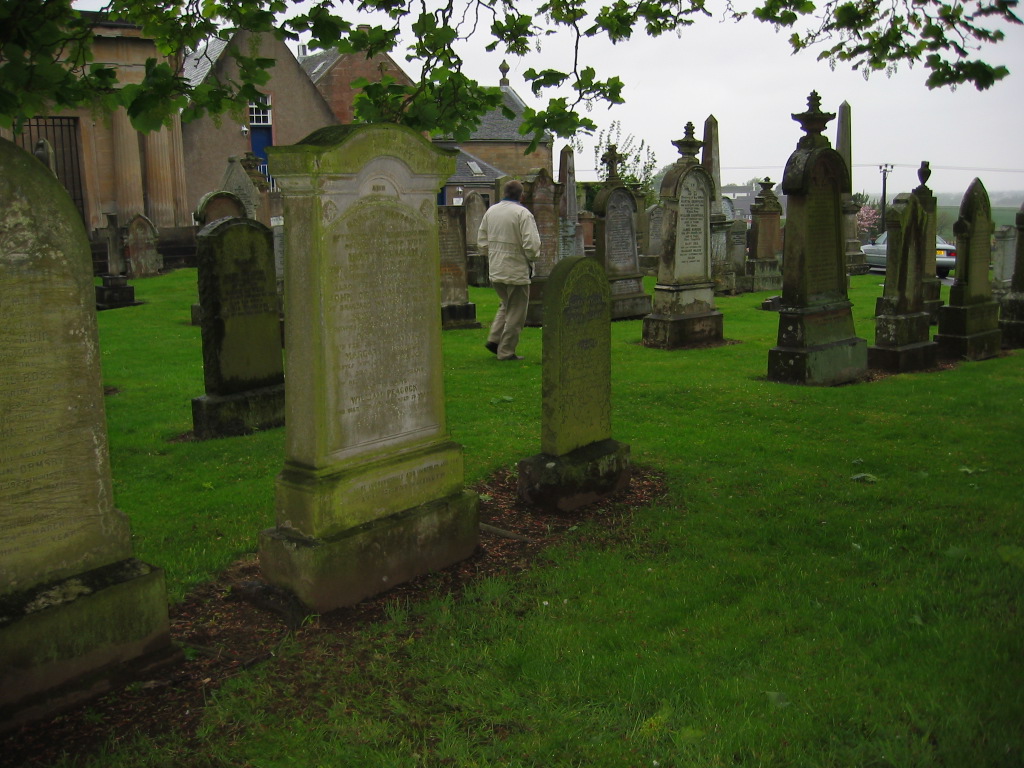
Ormsby family graves in St. Quivox Parish, Photo taken by the author 2003

ORMSBY, John (About 1787 – ?)

Tags

,

[for Ormsby family see page ‘ORMSBY’ at top of screen]

Although sources do not agree on the origins of the ORMSBY family name, it is an ancient one. Similar elements of most stories say the first Ormsby (or Ormesby) arrived in England with William the Conqueror. Ormsby’s likely moved to Ireland due to the religious conflicts during the reign of Elizabeth I (1558-1603). Several branches of the family settled in the counties of Roscommon, Sligo, and Mayo.

While it is not known from which county the Ormsby family in this story came, John Ormsby was from Ireland.

At this time little information is known about John ORMSBY, his wife or children other than his son James ORMSBY [see post 22 October 2012]. It is assumed at this point that the family lived in Ireland as John’s son James was born in that country about 1807. John would have married before James’ birth in 1807. If John was twenty years old (an estimate) at the time of his marriage he would have been born about 1787.

The ORMSBY family of Brickrow Farm, Ayrshire, Scotland

As described in ‘ABOUT THEIROWNSTORIES’ [see page at top of screen] I became intrigued by an inherited box of nameless photographs. I have always thought of my great-grandmother Jane (MUIR) WATSON as the person responsible for keeping this collection of photographs together and safe. My great-grandfather Thomas WATSON was, according to family stories, a ‘dour Scot’, not easily given to nostalgia or sentimentality. I cannot imagine him taking the time or trouble to maintain this collection of photographs safely through years of moving from farm to farm in Scotland, a long, sea-sick inducing voyage to Canada, and the primitive pioneer farm living conditions in the prairies of Saskatchewan.

Why was this collection of photographs so important to my great-grandmother Jane (also called ‘Jean’)? With research I learned that both my Muir and Watson great-grandparents came from large extended families in Ayr, Ayrshire, Scotland. I learned that my great-grandmother had nine siblings; seven brothers and two sisters. When the Watson family immigrated to Saskatchewan in 1910, of the Muir family only Jean’s elderly parents (James MUIR and Helen MCNAB), one sister (Helen Ramsay (MUIR) ORMSBY), and two brothers (George Kennedy MUIR and Gilbert MUIR ) remained in Scotland – the rest were either dead or had emigrated to countries such as England, Australia, Africa or eastern Canada. Immigration to a new country in those days meant an almost certain permanent move; rarely did people have the money to return home for a visit. It is likely that Jean was homesick for Scotland and worried about her elderly parents whom she assumed she would never see again. Based on family photographs and records it appears that those who remained in Scotland were close, visited and attended weddings and family events together. Jean and her family were missed and her siblings stayed in touch by sending photographs and postcards commemorating family events whether happy (weddings) or sad (deaths). I believe that many of the photographs in the old box were sent by Helen to her sister Jean in Saskatchewan. I believe that the sisters were close and that I may learn more about the personality of my great-grandmother if I understand Helen’s life.

What was my great-grandmother’s sister Helen like? Family stories report that, in her later years, Helen was a domineering and unpleasant woman, accustomed to having her own way. When her youngest child Henry (‘Harry’), who had lived with his mother for 36 years, married, Harry’s sister Margaret took a job as a housekeeper in another town and took their mother with her, to relieve the situation and give Harry and his wife a chance to live on their own at Brickrow Farm without Helen’s domineering presence. Were there circumstances in her life that formed her character?

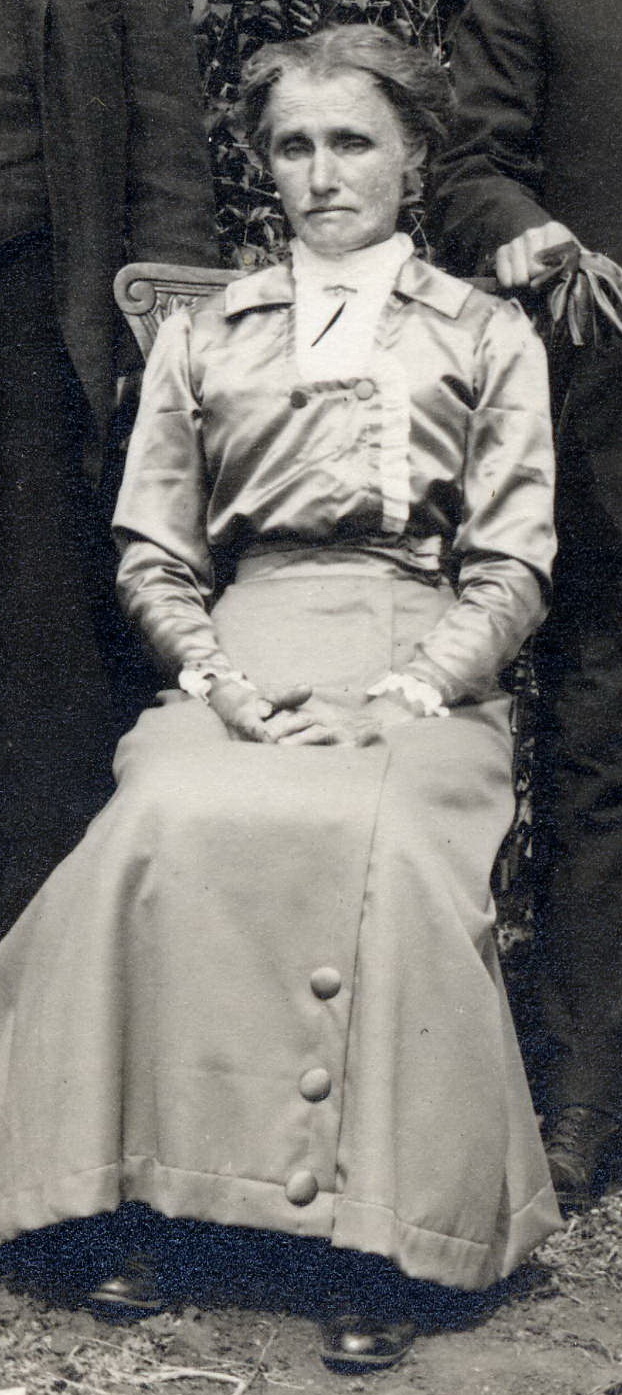
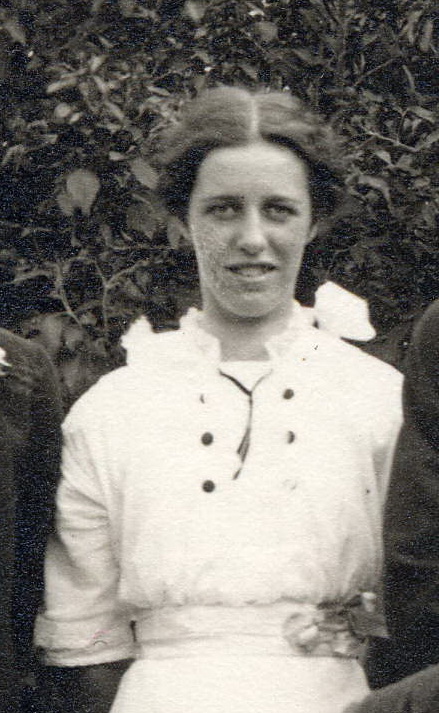
Photo below left: Jane (Jean) (Muir) Watson, 10 June, 1914, Lemberg, Saskatchewan, Canada. Photo below right: Jean’s sister Helen Ramsay (Muir) Ormsby, October 24, 1924, Ayr, Scotland. The specific dates and locations of the photos are known since each was taken at a family wedding.

The only photograph (right) I have seen of Helen was taken October 24, 1924 at the wedding of her daughter Jean. Helen, 50, appeared to be a worried and unhappy woman, however a son had recently died, she had just buried her brother-in-law and her father, 81, was gravely ill and died less than three months later. By 1924 she had already buried four children. While a formal unsmiling demeanour was required in photographs of that time, her life was filled with many challenges.

She may have even envied her sister Jean. Although Jean’s life in pioneering Saskatchewan was not easy, the move had been successful. Her children were healthy, were land owners, had married, had children. This had signaled a new start for the Watson family, a start that Tom Watson said he “wished he had taken 20 years earlier”.

While I started with the intent of telling the story of Helen Ramsay MUIR and her husband John ORMSBY, it soon became apparent that her story could only be told in the context of the whole Ormsby family and Brickrow Farm. When 20 year old Helen married 38 year old John and moved to Brickrow in 1894, three generations of Ormsby family had already lived at the farm for at least 43 years. There is no doubt that expectations and traditions had already been established. Her life at Brickrow for the next 53 years was interwoven with Ormsby family events and Brickrow Farm.

Searching for information on the Ormsby family led to a rich treasure trove of material, much of it unknown to me and I believe others in the family. One brother of John Ormsby left Scotland to join the excitement of the New Zealand gold rush in the late 1800s. Additional research revealed unknown stories of two Scottish brothers who were born in the early 1890’s, who ventured abroad, were caught up in the First World War, who survived and the direction their lives took later. The research, which involved accessing civil registrations, military records, electoral records, passenger lists and cemetery records, identified trails the brothers took through Scotland, England, Singapore, Malaya, Australia, Turkey, Egypt and France.

It was against this canvas of world and Ormsby family events and activity that Helen and John Ormsby lived their lives. This then [and the next posts], is the story of Helen Ramsay Muir, her husband John Ormsby and the Ormsby family of Brickrow Farm.

Watson Family: The Backstory

Tags

(see ‘Thomas & Jane (MUIR) WATSON Family’ under heading ‘WATSON’ , for photograph of WATSON family see post 29 April 2012)

[this post last edited, new information and/or images added 12 March 2013. Unless otherwise indicated all photos are from the author’s collection]

[For more Watson family photos also check out Donald Slater’s family history Flickr account www.flickr.com/photos/palaeoecogeek]

The skirl of bagpipes, swish of kilts, tales of Bonnie Prince Charlie, star crossed lovers on the shores of Loch Lomond, princesses who lived in castles, the romantic lairds of Sir Walter Scott; those were the images I had of Scotland when I was a child. I knew that my grandmother (Helen McNab (WATSON) ACTON), known as ‘Nell’ to adults, ‘Granny’ to we children) had been born in Scotland. I suppose she spoke with a slight Scottish burr, the residue of her Ayrshire accent that remained even though she had been in Canada for nearly forty years by the time I first became curious about my background. But I don’t remember her voice or accent.

I do remember that Granny never spoke of Scotland, or of her life there. One day, my curiosity got the better of me. I screwed up my courage since she seemed to never welcome questions about Scotland. I asked her if there wasn’t a laird or two in our background? I’ll never forget her reply. She chuckled and said ”no, there were no lairds, more likely road thieves.” At the time I wasn’t even sure what a ‘road thief’ was.

Later in life, as I learned more about Scotland and its history, I replaced my images of romantic lairds and clan chiefs with the more realistic vision of Highland Clearances, the extreme poverty of the crofters, people being starved out of their homes and forced to emigrate under appalling conditions at sea. I also learned how the industrious and hardworking Scottish people spread out across the world and have been instrumental in world development.

Princesses who lived in castles, evicted crofters, industrial magnates or road thieves; which were our ancestors? I decided it was time to start researching the Watson family.

Lowlands and Highlands of Scotland

My first research revelation occurred when I learnt the differences between the Scottish Highlands and the Lowlands. I had thought that all Scottish people had a relatively uniform background. However, historically Scotland was a land divided. In the Lowlands the people are of Anglo-Saxon stock, more like their English neighbours. To the north there is the Scotland of the Gaelic speaking Highlander. In the Hebrides, Orkneys and Shetlands, there is yet another society more akin to Scandinavia due to centuries of sea invasions from that area. These three distinct peoples were suspicious of each other and many vicious and bloody battles were fought. Even after Scotland was unified people from these areas continued to be wary of each other.

Our Watson family is from Ayrshire in the Scottish Lowlands and has been so since at least the early 1700s. To date the earliest direct link that I have been able to prove is to John WATSON, tenant farmer and labourer (born about 1717, Dundonald Parish, Ayrshire, died 11 January 1782, Dundonald Parish, Ayrshire) and his wife Agnes FREW (born about 1717 – died unknown).

My research also showed that our Watson family did not fit any of my preconceived ideas. We are descended from a long line of hardworking (no princesses), honest (no road thieves), Lowland (no clan chiefs or evicted crofters) labourers and tenant farmers.

Life as a tenant farmer in Scotland in my ancestors’ time was not at all what I had known in my own comfortable Saskatchewan upbringing on my parent’s farm. My parents and all the neighbours, although small landowners by today’s standards and certainly far from wealthy, owned their land and could develop and manage it as they determined. We never wanted for food; huge vegetable gardens, fresh wild berries and our own livestock (chickens, turkeys, cattle, pigs) provided a varied and healthy diet.

Many Scottish land ownership practices are completely different from those of Canada; understanding these gave me a better understanding of the hardships of the Watson family in Scotland, the reasons for the family’s move to Canada; and an appreciation for the determination, courage and initiative this move entailed.

Land Ownership and Farm Life in Scotland

Land ownership in Scotland, to this day, follows patterns established centuries ago. Since earliest times feudal lords, kings, titled nobles, clan chiefs and landed gentry fought frequently and furiously over land. Lands and authority were given as a reward in exchange for loyalty and the promise of enough men to raise an army.

Immense fortunes were made, and lost, as ownership changed hands as a result of the numerous wars that have marked the history of Scotland and England. Once land ownership was in a family, it was handed down through the generations to the eldest son. This inheritance was often interrupted if the property title was lost through battle, war or allegiance to the losing side in a political skirmish. “To the victor go the spoils” was accepted practice and often ownership of thousands and thousands of acres and miles of countryside would change hands as the result of a battle.

A mile of countryside by itself of course had no value, but rather it was the resources found in, or on, the land within that area that were worth a fight. Natural resources, such as lead and gold, made some land valuable. For a large portion of the land the value lay in what was on it, i.e. people who worked the land and paid rent. As an example, if a person (almost without exception a man) owned land where 10,000 families lived and worked then all those people paid rent and owed allegiance to the landowner. Often several small villages were (and still are) part of the property; shop keepers and village people also paid rent to the owner. The rental payments invariably made the landowner an extremely wealthy man, and while the owner had a few obligations to the tenants, the onus was on the tenants or renters to find the money to pay the rent.

This relentless search for rent money was constant and frequently debilitating. In the case of a farm, if a tenant farmer improved the property in an attempt to increase production, and therefore earn more to support his family, the owner often increased the rent based on the rationale that the land was worth more. This was a catch-22 situation that sapped initiative and ensured that most tenant farmers were trapped in a never ending cycle of near-poverty. For tenant farmers ownership of land was not even a dream. Not only was the money to purchase the land impossible to save, but the land simply was not available for purchase. Persons born to this station in life were destined to spend their lives working for a ‘laird’ or the owner’s representative (‘factor’) who lived in ‘the big house’.

Tenant farmers usually worked under a contract or lease arrangement. Often this contract was for a year; the tenant farmer and all his family were expected to work on the farm and were part of the contract. Each summer in every county or ‘shire’ at the annual fair, tenant farmers and owners / factors could meet and discuss arrangements for contracts and positions. If a tenant farmer decided to take a different position and move his family to another farm, it was often at this fair that arrangements were made. A handshake usually sealed the contract.

Farms were often large and required several families of tenants to work them. In this case there was a division of labour. ‘Ploughman’, ‘cattleman’, ‘dairyman’ were just a few of the occupations required. Farming practices were basic and extremely labour intensive. Work was hard, dirty, thankless, unprofitable and never-ending.

Tenant families usually lived on the farm, often in one of several cottages provided on the property. These cottages were primitive, certainly with none of the conveniences now considered essential for living and raising a family. Conditions were normally damp, dark and cold in Scotland’s continual rainy climate. Food was extremely basic; it was a treat to be given a small piece of an egg yolk my Granny told me.

Watson family life in Scotland was that of a typical tenant. For several generations Watsons lived and worked as tenant farmers with no hope or opportunity of owning land or directing their own destiny. Granny did later say that they “always felt like peasants in Scotland”. The Watson family moved often as Thomas, the father and bread-winner, attempted to provide for his family by taking different positions in different areas of the country. This is the story of their life in Scotland and the move to Canada which changed their lives and those of their descendants irretrievably.

(for the stories of the Watson family members see posts 14 May – 22 May 2012)
MUIR, John (1872-1921)

Tags

, , , ,

(see page ‘James and Helen (MCNAB) MUIR Family’ under heading ‘MUIR’ top of screen)

(post edited 14 September 2012, 14 December 2012, 06 April 2018)

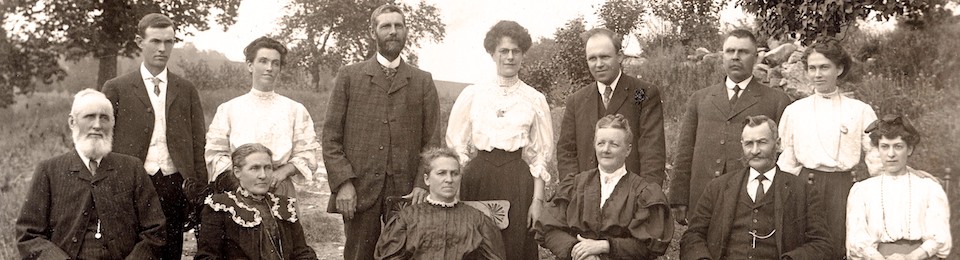
Help needed – is John MUIR one of the unknown people in the photo used in the banner of this blog?

Since my last post I have been to Ayr Scotland, home of many of my ancestors. A trip to the Ayr Cemetery on Holmston Road brought to light this little gem about my great-uncle John, the brother of my great grandmother Jane MUIR:

“In Loving Memory of my dear husband John MUIR, [died] Dean Cottage, 9 December 1921 aged 49 years. Also his wife Agnes W. R. MUIR 30 December 1945, aged 70 years”

I was surprised to see this Memorial Inscription as my deceased father had left a note saying that John had ‘gone to Kenya’. I had been able to locate the dates of John’s birth and marriage, and some census records, but then had lost him, I presumed to ‘Kenya’.

Clearly John had not died in Kenya. What was the story here?

John was born at 6:30 AM, on 30 April 1872 in Beoch, Maybole, Ayrshire, Scotland. His father, James MUIR, was a farm overseer at the time of John’s birth. John was the 4th child and 3rd son of James and his wife Helen MCNAB. Eight year old John was with his family at Slaphouse Farm, Ayr in the 1881 census. He attended a local school, likely Alloway, with the rest of his siblings. His father James occupied the position of ‘bower’ (probably a farmer who tended cattle) at Slaphouse Farm. (photo below).

Slaphouse Farm, Ayr, Scotland.

Photo taken by the author November 2010

By the time of the 1891 census John lived with his family at Mainholme Farm, just outside Ayr. James, John’s father was the tenant Farmer of Mainholme. Unmarried, John was 18 years old, had completed school and worked as a ‘farmer’s son’ full time at Mainholme. Ten years later, in the 1901 census John, 28 years old, still lived with his family at Mainholme Farm and worked full time on the farm. By this time several of his nine siblings had left home, married and started their own families.

The 1901 census also lists Agnes Wilson RUSSELL, whom John married  on 12 December 1902. The marriage took place at the Athole Arms [Hotel] in Ayr. John was 30 yrs old and Agnes 27.

It is possible that John and Agnes appear in the family photograph used in the banner of this blog, which was taken about 1900 outside Mainholme Farm where John’s parents still lived. No photograph of John or Agnes has yet been found or identified for comparison.

Agnes, was born 8 November 1875 at New Barns, St. Quivox, Ayrshire to James RUSSELL, labourer, and Isabella WILSON. In the 1901 census Agnes is living with her 65 year old father James (woodman (estate)), mother, brother David RUSSELL, 27, woodman (estate), and 25 year old sister Anna Bella RUSSELL. Place of residence is New Barns, St. Quivox where they had lived at least since the time of the 1881 census.

For 20 years after the marriage of John and Agnes, they disappear from normal documentary evidence. They do not appear in the 1911 census in Scotland – at least I haven’t found them yet.

The next thing known for certain about John is that he died at Dean Cottage in Ayr on 9 December 1921. He was only 49 years old. Cause of death was ‘tuberculosis of bladder and prostate’ which had been diagnosed for at least 12 months. His occupation was listed as ‘farmer’. Dean Cottage, where John died, was the home of his parents, James and Helen (MCNAB) MUIR, retired famers, both of whom were still living.

John’s wife Agnes was the informant of his death so we know that she was also in Ayr at that time.

Agnes, who lived for another 24 years, died on 30 December 1945 at 82 Brownside Drive, Glasgow. Her usual residence was 45 Loudon Road, Newmilns.

Did John and Agnes go to Kenya? John had worked all his life on farms; did he use this experience to branch out in a new country? This is possible as others from Ayr, including possibly at least one of John’s brothers, had gone to ‘Africa’ to work as farm managers or labourers. With John’s agricultural experience was he a farm manager on one of the big Kenyan estates? Did John and Agnes go to Kenya shortly after their marriage and come back to Scotland when they learned that John was seriously ill? If so, is that why John died at the home of his parents? This might be the case if they returned to Scotland without the resources, or time, to acquire their own living arrangements before John’s death.

A thread of a clue about John and Agnes’ location between their marriage in 1902 and John’s death in 1921 is offered in Agnes’ 1945 death registration and ship passenger records. At time of Agnes’ death she was identified as the widow of John MUIR, Farm Manager. A search to date of passenger records both leaving and returning between the UK and ‘Africa’ in the 1902-1921 period has produced only one clue, but it may be significant: On 1 March 1913 the ship ‘Goorkha’, arrived in London, England from Mombasa, East Africa. Two of the passengers are “Mr. J. MUIR, 40, Farm Manager’ and Mrs. A. MUIR, 35”. The names, ages, date, occupation, and place of departure fit. Is this John and Agnes?

The informant of Agnes’ death in 1945 was a niece with the surname GRAY.  Hopefully more research will turn up information about the missing years in John and Agnes life, and whether or not they were in Kenya. And whether John is one of the people in the photo used in the banner of this blog. With this information we could help John and Agnes tell TheirOwnStories.

Watson Family Moves to Canada

Tags

, , , , , , , ,

(see ‘Thomas & Jane (MUIR) WATSON Family’ under heading ‘WATSON’;  for photograph of WATSON family see post 29 April 2012)

[this post last edited, new information and/or images added 12 March 2013. Unless otherwise indicated all photos are from the author’s collection]

[For more Watson family photos also check out Donald Slater’s family history Flickr account www.flickr.com/photos/palaeoecogeek]

The Thomas and Jane (MUIR) WATSON family came to Canada in four stages.

First to arrive was 17 year old James Muir (Jim) WATSON, who arrived in Montreal on the 19 June 1906, after a ten day sea journey from Galsgow, aboard the ship ‘S. S. Corinthian’. He travelled to Winnipeg by train and worked for a Manitoba farmer as an agricultural labourer.

The second of the Watson family to arrive in Canada was 17 year old William (Bill) Watson Muir WATSON who sailed from Glasgow on the ship ‘S. S. Hesperian’ and arrived in Quebec City on 19 July 1909. His eventual destination was Rapid City, Manitoba.

The main group of the WATSON family (father Thomas WATSON, mother Jane MUIR, Nell, 20 [Helen McNab WATSON], Alex, 15 [Alexander Hunter WATSON], Jane, 11 [Jane Muir WATSON], and John, 7 [John Mcconnell Muir WATSON]) left Glasgow, Scotland on 2 April 1910 on the ship ‘S. S. Hesperian’, which docked in Halifax on 11 April 1910.

Thomas (Tom) WATSON, 25, the last of the family to move to Canada, sailed from Glasgow on 17 June 1912 on the ‘S. S. Pretorian’, and arrived in Montreal about eight days later.

The Sea Voyage 

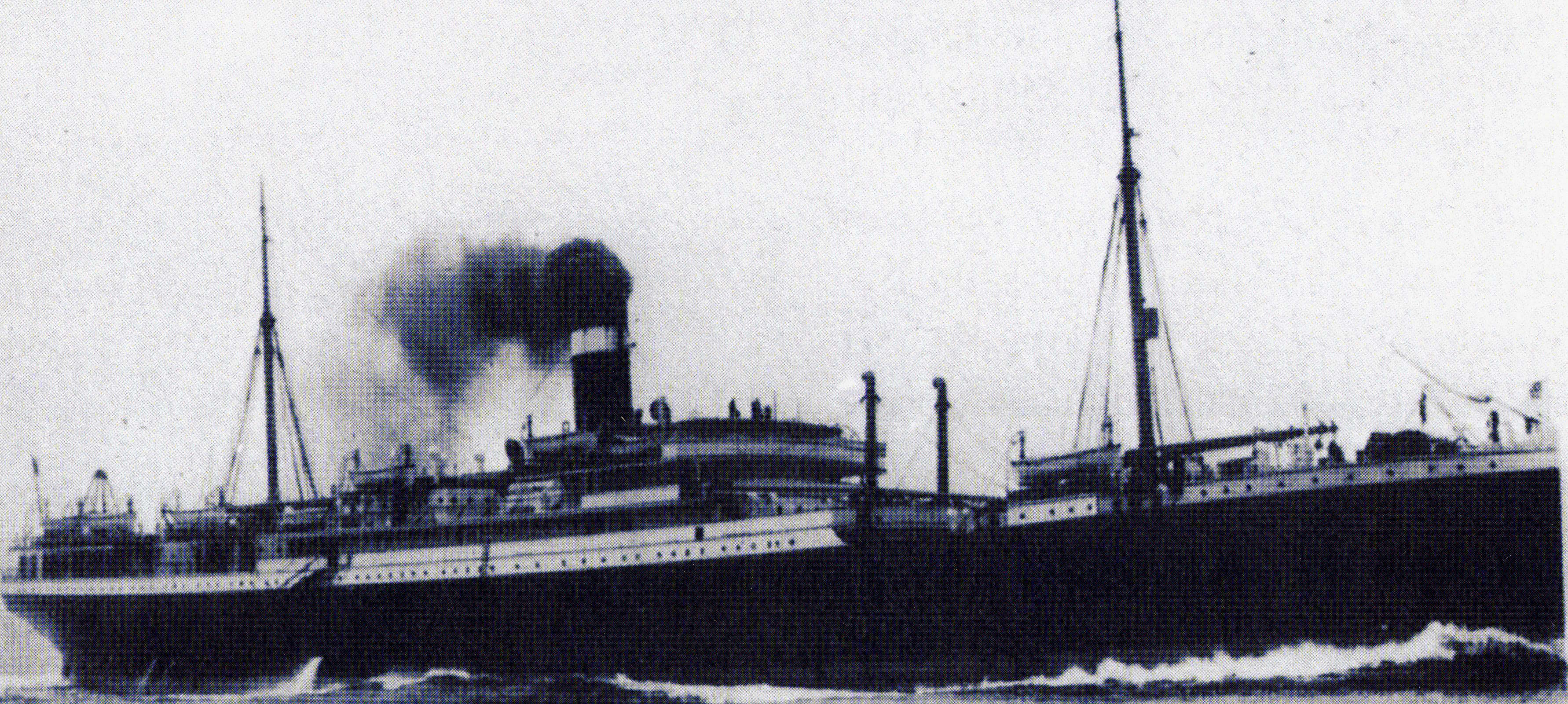
The Watson family (Thomas, Jane, Nell, Alex, Jane, and John) boarded the ‘S.S. Hesperian’ in Glasgow on 2 April 1910 with all their worldly possessions. The next day the ship stopped in Liverpool to pick up additional passengers. The sea voyage from Liverpool to Halifax took eight rough, sea sick days.

 S. S. Hesperian, Allan Line, Glasgow, Launched 1907, torpedoed and sunk by a German submarine 4 September 1915

The S. S. Hesperian’s Manifest listed the ‘Number of Souls’ on board as 1,416. Of that number 1,150 souls were housed in the bowels of the ship in 3rd class or ‘steerage’ even though the allowed legal limit was 1,000 people. In this overcrowded, cheap and substandard accommodation, hundreds of immigrants were housed in one large room, with shared sleeping, eating and bathroom facilities. One can only imagine the claustrophobia of bouncing over the Atlantic Ocean during the April storms, enduring sea-sickness in the dimly lit area, surrounded by hundreds of other sea sick passengers.

Newspaper headlines of the time gave some indication of the situation “Steerage conditions called appalling”, “Abuses among emigrant passengers” and “Horrible conditions endured by emigrants in steerage”.

The six Watson family members were among the miserable steerage passengers. My grandmother Nell [Helen McNab Watson], would speak only rarely and reluctantly about the trip, and never wanted to return to Scotland. And she never did.

However, for the Watson family and hundreds of thousands of other immigrants, however horrible the conditions in steerage, the price was right and this was the way to the promised land and a new start on life. The total fare for the six Watson family members was $25, covered by ‘British Bonus Allowed’. This was a commission paid by the Immigration Branch of the Canadian Government to steamship booking agents in the United Kingdom to encourage immigration of desirable settlers, mainly farmers, who were prepared to move to Canada. It encouraged steamship companies to recruit settlers and was a marketing tool of the Canadian government.

The family landed in Halifax on 6 April, 1910 at 6:45 a.m. I have always imagined that it was a cold, dreary, rainy April morning. Port of entry was not the now famous Pier 21, but Pier 2, which combined a deep water shipping terminus with a Canadian Pacific Railway terminus. [Pier 21 was not opened until 1923].

Once landed in Halifax the travails of the passengers were not over as all had to pass medical inspection. The ‘S. S. Hesperian’s’ Manifest for this voyage noted that the medical inspection of the steerage passengers commenced at 8:05 a.m. and was not fully completed until 4:00 p.m.; two passengers were detained. Connecting trains left at 2:00 p.m., 5:00p.m., 7:00 p.m. and 9:00 p.m.

Arrival in Wolseley

After several days the train reached Wolseley, Saskatchewan. It is not known how Wolseley was chosen as a destination, however Thomas had probably answered an advertisement for a farm labourer through a newspaper in Scotland. Once they arrived in Wolseley, the six Watson family members received a terrible shock. When the farmer who had hired Thomas showed up with his horse and cart and found out that there were six family members and not just one man, he turned around and left them standing at the railway station. In Scotland when a tenant farmer was hired it was understood that the whole family was included and all were expected to work. In Canada this was not the case. Although the misunderstanding was easily explained it did not make it any less serious for the Watsons. The Watson family was devastated, they had come all the way from Scotland and had nowhere to turn.

Fortunately for the Watson family, Mr. G. P. Campbell heard of their situation, picked up the family and took them home. Several Watson family members worked as hired help for the Campbell family until they were able to establish themselves on land.

Gradually the family established themselves, bought land, married, raised families and became involved in the community. For the Watson family members Canada was indeed the start of a new life, and provided opportunities they would never have had in Scotland.

WATSON, John McConnell Muir (1903-1994)

Tags

, , , , , , , , , ,

(see ‘Thomas & Jane (MUIR) WATSON Family’ under heading ‘WATSON’)

[this post last edited, new information and/or images added 12 March 2013. Unless otherwise indicated all photos are from the author’s collection]

[For more Watson family photos also check out Donald Slater’s family history Flickr account www.flickr.com/photos/palaeoecogeek]

 WATSON1914-001-600-1eJohn McConnell Muir WATSON, born in 31 December 1903, was the eighth child and fifth son born to Thomas WATSON and his wife Jane MUIR. At the time of John’s birth, the nomadic tenant farmer Watson family had moved to Knockhouse Farm, Dunfermline, Fife, Scotland where John’s father had taken work as a dairyman.

Photo left: John McConnell Muir Watson, 10 June 1914, Rosewood District, Lemberg, Saskatchewan, Canada

One of John’s middle names was ‘McConnell’ after John McCONNELL who had married his father’s sister Isabella WATSON. The Watson and McConnell families were close as can be seen by surviving postcards. The Watson children seem to have visited the McConnell’s frequently.

John was the youngest in the family; sixteen years separated John and his eldest sibling Tom [Thomas WATSON]. Within two or three years of John’s birth his four elder siblings had already left home to work. In 1910 when the family immigrated to Saskatchewan John was seven: he continued his schooling once the family reached their new home. His boyhood in Saskatchewan was much different than that of his older siblings who were raised in Scotland.

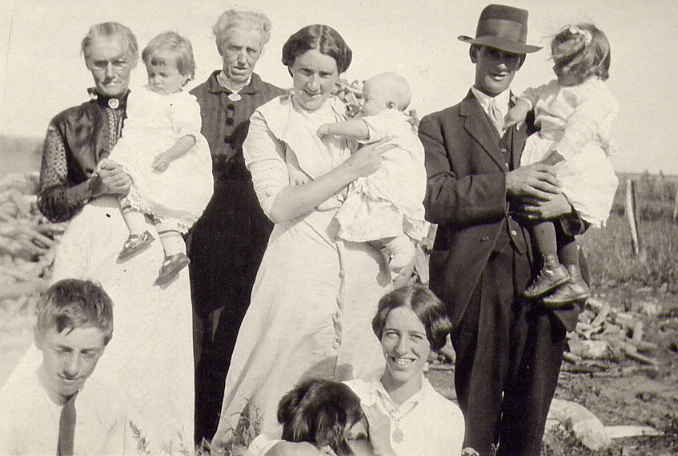
Photo right: John, lower left hand corner, with a pet dog and sister Jean [Jane Muir WATSON]. Standing, left to right, John’s mother Jane, John’s aunt Janet [Janet (WATSON) SPEIRS], John’s sister-in-law Nancy [Agnes Elizabeth (ACTON) WATSON] and John’s brother Jim [James Muir WATSON]. The young children being held are John’s nieces and nephews, children of Jim and Nancy Watson. Photo taken about 1918 in the Rosewood district of Saskatchewan. From the author’s collection.

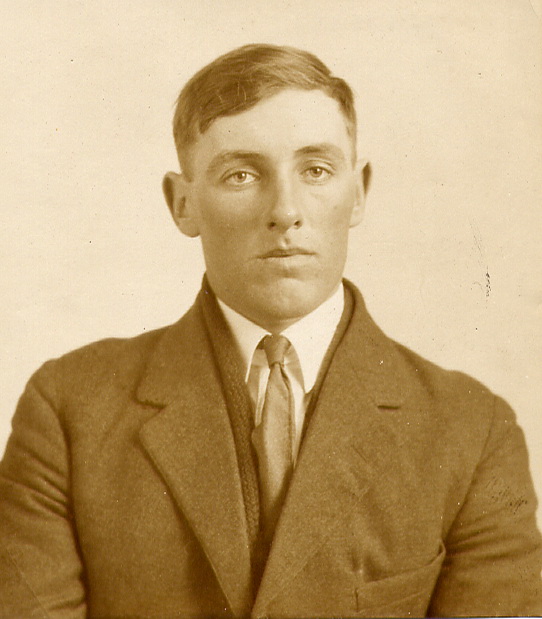
Photo left: John about 1928, Lemberg, Saskatchewan, Canada

From the author’s collection

During the early years of the 1900s John’s siblings left home to marry and his sister Jean moved to Regina for work. John and his parents continued to live together on his farm in the Rosewood district. It was here that his father Tom died in 1932. John’s mother Jane continued to live with him until her final illness in 1933 when she moved to her daughter Nell’s [Helen McNab (WATSON) ACTON] farm home just a few miles away.

John continued to live year round on his farm until 1957 when he built a home in Lemberg and lived there during the winter months, and continued to farm in the summer.

WATSON1955-003Photo right: John’s farm, the car is in front of the house

Photo left: John in mid-1940s

John never married although he was probably the most gregarious of his brothers, and enjoyed a social life. He was a constant fixture at the many Watson/Acton picnics and get-togethers, and community events. He enjoyed some travel to the United States and Churchill, Manitoba. He also visited his brother Jim and sister-in-law Nancy after they moved to Vancouver Island in 1945. He never spoke about Scotland nor returned there, but was only 7 when he arrived in Canada and his memories of Scotland may have been dim. He was active in the community, supported local events and activities and was a member of the Wolseley Hospital Board.

Photo right: John (with a new car?)

John eventually sold his farm to a neighbour and moved permanently into Lemberg, where he lived for some years. The last years of John’s life were spent in the senior’s residence in Balcarres, Saskatchewan, a neighbouring town of Lemberg. Popular opinion at the time was that he had “checked himself in early” as he was mentally agile, physically fit and in good health. However, he apparently knew what was best for him when he decided to move there. A life-long congenial bachelor, he enjoyed the activities, company and having someone do the cooking and cleaning.

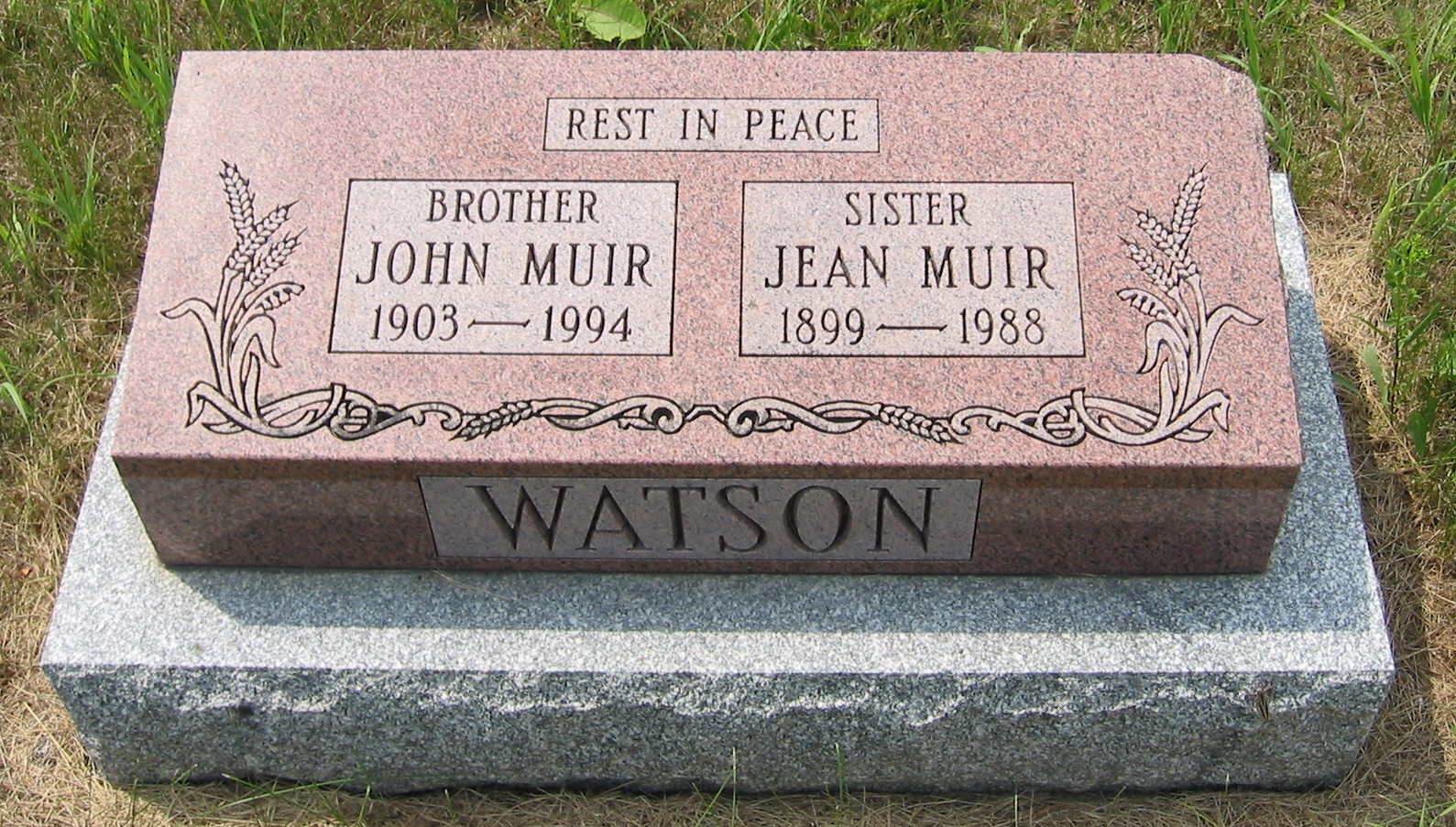
John died in Balcarres on 19 April 1994, 91 years old. Ever the community minded citizen, John left his estate to the Balcarres Seniors’ residence, his home for many years, and to local charities.

He is buried in Ellisboro Cemetery, Saskatchewan beside his sister Jean.

WATSON, Jane Muir (1899-1988)

Tags

, , , , , , , , , ,

(see ‘Thomas & Jane (MUIR) WATSON Family’ under heading ‘WATSON’)

[this post last edited, new information and/or images added 12 March 2013. Unless otherwise indicated all photos are from the author’s collection]

[For more Watson family photos also check out Donald Slater’s family history Flickr account www.flickr.com/photos/palaeoecogeek]

Jane (Jean) Muir WATSON was born 10 January 1899. She was the seventh child and third daughter of Thomas WATSON and his wife Jane MUIR. Her father had taken a job as a ploughman at Newton Farm, Cambuslang, Lanarkshire, Scotland and they lived in one of the farm cottages where Jean was born.

Photo left: Jane (Jean) Muir Watson, 10 June 1914. Rosewood District, Lemberg, Saskatchewan, Canada

Jean’s sister Nell [Helen McNab WATSON] was nine years older than Jean and it is probable that Nell was required to care for the baby. Their mother Jane would likely have been preoccupied with the toddler Mary [Mary Hunter WATSON], who was ill and died just over a year after Jean’s birth. Nell and Jean were close all their lives and visited almost weekly until Nell’s death in 1967.

Although Jean was the second youngest of Tom and Jane’s eight children, she likely did not long enjoy the position of cared-for younger sister. By 1905, when Jean was 6, both her older brother Tom [Thomas WATSON] and her beloved sister Nell worked away from home. In 1906, when Jean was 7, her brother Jim [James Muir WATSON] left to seek his fortune in far-off Canada and started the family’s eventual move to that country. In 1909 her brother Bill [William Watson Muir WATSON] followed Jim to Canada. After Bill left the Watson family at home consisted of only Jean, 10, and her older brother Alex [Alexander Hunter WATSON], 14, younger brother John [John McConnell Muir WATSON], 6, and her parents. As the eldest daughter at home Jean would have responsibilities to help her mother cook and clean, as well as attend to her own school work.

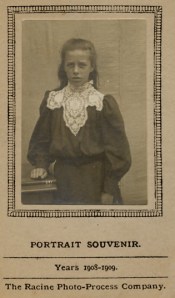
WATSON1908-000Some 1909 photographs from Jean’s school in Scotland have survived. Photo right: Jean’s School photograph for school year 1908-1909.

Photo below: Jean Watson, seated front row, 1st person on left, Class photograph for school year 1908-1909, Gullane, Scotland

scan-19May-0002

In April 1910, when Jean was 11, she was part of the Watson family that immigrated to Saskatchewan. She continued her schooling in the Rosewood area, and was involved in community activities such as the Red Cross.

In her late teens Jean moved to Regina and took a secretarial course. She worked at the Regina branch of Credit Foncier, a large mortgage company with offices across Canada. She was employed by the company for many years, probably as a senior secretary or administrative assistant, until her retirement in the 1960s.

Her apartment, in the Credit Foncier building, was a window-filled corner unit which overlooked the manicured green lawns and flowers of Victoria Park in downtown Regina. It was a tiny unit – although it seemed large when I was a child – filled with lovely furniture and nick-knacks. My country cousins and I were always amazed at the compact neatness of the apartment. We were also amazed at the concept of such a small living space since many of us lived on sprawling farms with homes that leaked dust and weather. To be asked to spend a few days staying with ‘Aunt Jean’ (as she was known to everyone) in her Regina apartment in the centre of a big city was a treat beyond words when we were growing up.

Aunt Jean was everyone’s favourite aunt and regularly visited her siblings and their offspring. Dozens of photos exist documenting her numerous visits which were highly anticipated as her suitcase always carried small gifts and treats for every child. She was a welcome visitor in all our homes. A happy, fun loving person she was, within reason, prepared to do anything to the delight of we children. She was always smiling, or laughing, or preparing to do so. Her hair, which turned a lovely soft white during her 20s, was always neatly pinned. I don’t remember seeing her wear anything other than a dress and smart shoes; but her stylish attire didn’t stop her from climbing either onto a horse cart or up into the loft of a barn.

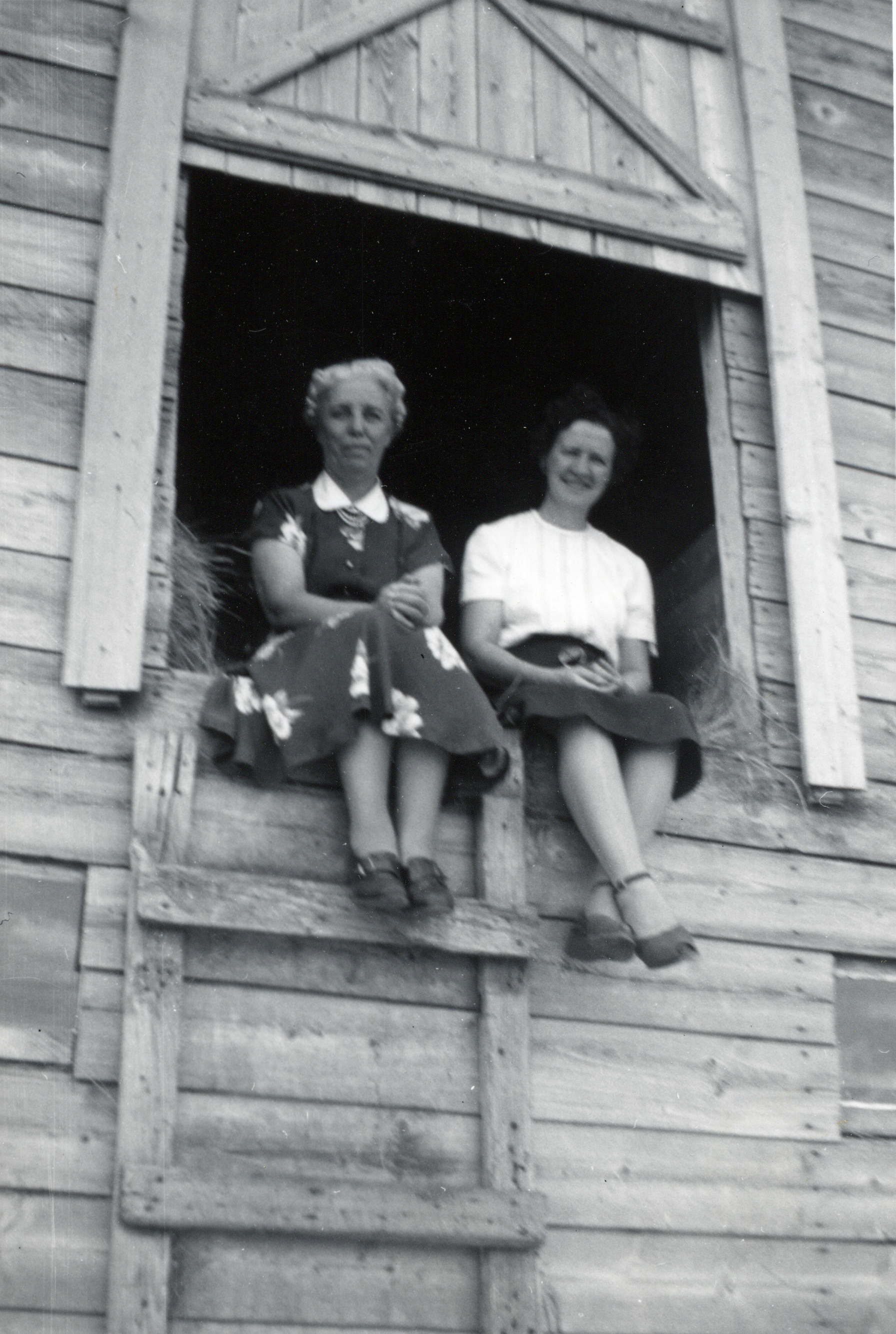
Photo right: Jean, left and unknown friend enjoy the view from the loft of a barn, Saskachewan. about 1950s?

Photo from the author’s collection

Jean and her sister Nell remained particularly close. For years each weekend Jean traveled by bus (for all her independence she never learned to drive) from Regina to Lemberg to stay with her sister and brother-in-law Joe [Joseph Francis ACTON].

Photo below: Jean, centre in blue dress, with her sister Nell and brother-in-law Joe.

Photo taken in Lemberg, Saskatchewan, about 1962

From the author’s collection

After her retirement in the 1960s Jean moved to Calgary. A few years before her death she returned to Saskatchewan and moved into the senior’s residence in Balcarres where her brother John lived.

She died in Balcarres on the 27 June 1988, and is buried beside her brother John in the Ellisboro Cemetery in the Qu’Appelle valley.

WATSON, Mary Hunter (1897-1900)

Tags

, , ,

(see ‘Thomas & Jane (MUIR) WATSON Family’ under heading ‘WATSON’)

(this post last edited, new information and/or images added 27 December 2012)

Mary Hunter WATSON was born 12 July 1897 at 14 High Street, Paisley, Renfrewshire, Scotland. She was the sixth child of Thomas WATSON  and his wife Jane MUIR. As their second daughter she was named according to the Scottish naming pattern; Mary HUNTER was her father’s mother. At the time of her birth her father was a dairyman, perhaps for a larger farm nearby Paisley.

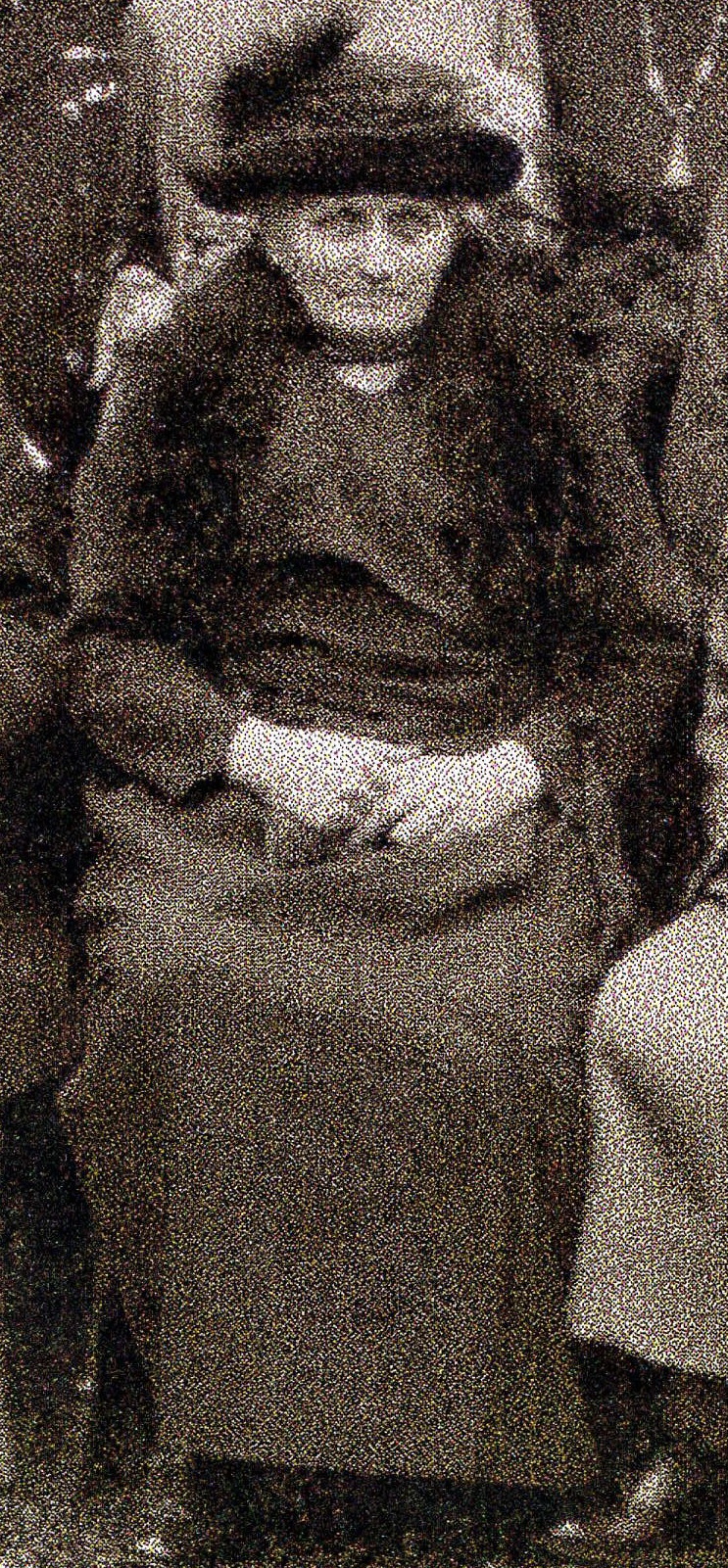
Photo left: believed to be baby Mary Hunter Watson on the lap of her paternal grandmother and namesake Mary Hunter. While positive identification has not been made, I believe that based on the cause of baby Mary’s death (below) it appears that her spine may have been twisted. And I believe that a photograph of the two Marys is something that the Watson family would want to have and keep.

Mary’s life was short and tragic; she was only 2 years and 10 months old when she died on May 23, 1900 at Newton Farm Cottages in Cambuslang, Lanarkshire, Scotland. Her death registration listed the cause of death as “Intusscheptas Tubes Mesentercia”. A medical dictionary defines intussusception as “The slipping of one part of an intestine into another part just below it; becoming ensheathed. It is noted chiefly in children and usually occurs in the ileocecal region. Prognosis is good if surgery is performed immediately, but mortality is high if this condition is left untreated for more than 24 hours.” (Source: Taber’s Cyclopedic Medical Dictionary, 18th ed., F. Davis & Co., 1997, pp. 1017)

Based on the photo of Mary with her grandmother I believe that she was born with a curvature of the spine, which led to her fatal condition in 1900.

The death of baby Mary was a tragic loss to the Watson family.